Welcome back to the fascinating world of baking science! Our esteemed contributor, Summer Stone of Cake Paper Party, returns today with an insightful experiment that challenges a long-standing baking myth.
The Overmixing Myth: What Really Happens When You Overmix Cake Batter?
For years, home bakers and professionals alike have been told to “mix briefly” or “mix just until combined” when preparing cake batters, especially to avoid “toughening” the final product. This advice is deeply ingrained in baking lore, often passed down through generations of cooks. But how much truth lies behind this adage, particularly when it comes to rich, American-style butter cakes?
As a passionate baker and curious scientist, I’ve always questioned conventional wisdom in my kitchen laboratory. My personal experience with butter cakes suggested that they don’t seem to toughen up, regardless of how long they’re mixed. This led me to develop a hypothesis: perhaps mixing time has little to no significant impact on the structure and texture of a butter cake. The results of my latest experiment, however, were truly astonishing and completely contradicted my initial assumptions – and I believe they will surprise you too!
Unveiling the Experiment: Testing the Limits of Mixing
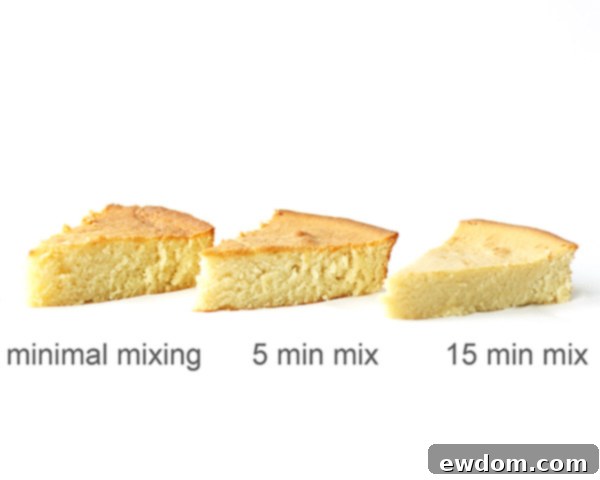
To put my hypothesis to the test, I prepared a standard butter cake batter, dividing it into three distinct batches. Each batch was subjected to a different mixing duration:
- Minimal Mixing: The batter was mixed only until the ingredients were just blended, with the final touches completed by hand to ensure no additional mechanical development. This represented the traditional “mix until just combined” approach.
- Moderate Mixing: This batch was mixed for a precise duration of 5 minutes. This extended period would typically be considered “overmixing” by many conventional recipes.
- Extended Mixing: The third batch was subjected to an extensive mixing time of 15 minutes. This was designed to push the boundaries and observe the absolute maximum impact of prolonged agitation.
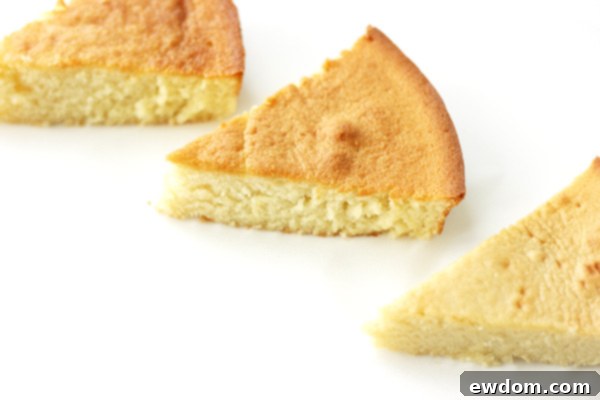
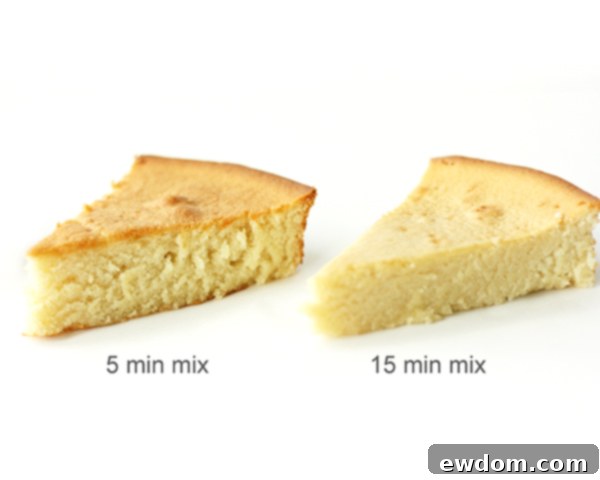
Once baked, the cakes emerged from the oven, revealing a dramatic and unexpected variation in their appearance and structural integrity. The visual differences alone were enough to suggest that mixing time, indeed, plays a critical and complex role in cake development.
The Delicate Balance: Understanding Cake Structure
Before diving into the surprising results, let’s establish a foundational understanding of how cake structure is formed. Every successful cake exists in a delicate equilibrium between components that build structure and those that weaken or tenderize it. Achieving the perfect cake texture requires a masterful balance of these elements.
Key Structure-Making Molecules:
- Egg Proteins: When heated, egg proteins coagulate, forming a strong, supportive network that sets the cake’s structure.
- Dairy Proteins: Proteins found in milk and other dairy products also contribute to the structural framework and richness.
- Gluten: Formed when proteins in flour (gliadin and glutenin) interact with water and mechanical mixing, gluten creates an elastic network that traps gases and provides chewiness and strength.
- Starches: Primarily from flour, starches absorb liquid and gelatinize during baking, contributing significantly to the cake’s crumb structure and moisture retention.
Key Structure-Weakening Molecules:
- Fats: Ingredients like butter and oil coat flour particles, hindering gluten development and resulting in a tender, “short” crumb. They also add moisture and richness.
- Sugars: Sugar is a tenderizer; it competes with flour for water, inhibiting gluten formation and starch gelatinization. It also caramelizes to contribute to browning and flavor.
- Liquids: While essential for hydration, excessive liquid can dilute structural components, leading to a weak structure.
- Acids: Acids (e.g., buttermilk, lemon juice) can weaken gluten and react with leavening agents to produce gas, affecting texture.
- Fiber: Found in whole grain flours, fiber can physically disrupt gluten networks, making cakes denser.
An imbalanced recipe is a baker’s nightmare. If your recipe is too heavy on structural components and lacks sufficient tenderizers, you might end up with a tall, impressive-looking cake that is unfortunately tough, chewy, and unpalatable. Conversely, a recipe overly reliant on weakeners may taste wonderfully moist and rich but will likely be short in height, prone to crumbling, and difficult to stack or slice. Bakers are constantly refining recipes, seeking that elusive perfect harmony of ingredients that delivers both optimal texture and delicious flavor.
The Gluten Conundrum: Why Butter Cakes Break the Rules
Traditionally, the primary concern with overmixing is the excessive development of gluten. In batters containing flour and water, mechanical action (mixing) activates the gluten-forming proteins. If there’s minimal fat or sugar to interfere, prolonged mixing can indeed lead to long, strong strands of gluten, resulting in a tough, chewy, bread-like baked good – think of kneading bread dough. This is precisely why bakers are often warned against overmixing.
However, rich cake batters, like those used in butter cakes, are characterized by high levels of fat and sugar. These ingredients are potent tenderizers, specifically designed to counteract the formation of robust gluten networks. In theory, the presence of ample fat and sugar should effectively minimize, if not entirely negate, the gluten-forming effects of extended mixing. My hypothesis stemmed from this understanding: with so many tenderizers, how could a butter cake ever truly become tough from overmixing?
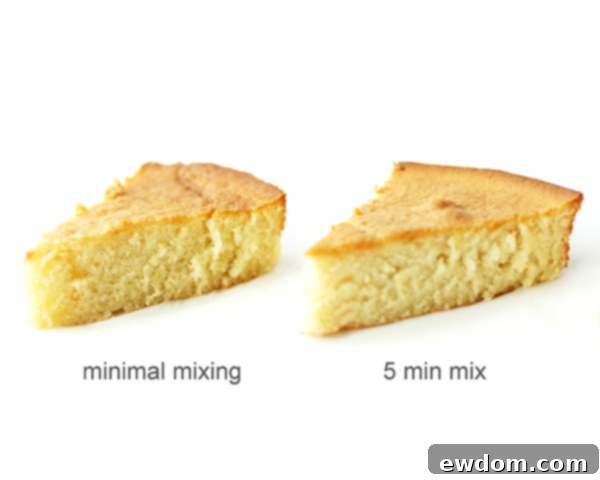
This is where my experiment delivered its most shocking revelation. Instead of promoting toughening, prolonged mixing actually led to a destabilization and significant weakening of the cake’s protein network. The cake that received the least mixing was surprisingly the strongest structurally, holding its shape with resilience. In stark contrast, the cake mixed for a full 15 minutes was incredibly fragile and tender – so delicate, in fact, that I struggled to remove it from the pan without it breaking apart. This outcome was a complete reversal of the commonly held belief and my initial expectations.
The Mechanics of Weakening: Why Overmixing Makes Cakes Fragile
The observed structure reduction and increased fragility in the overmixed butter cakes can be attributed to several interconnected factors, highlighting the complex interplay of ingredients and mechanical forces:
1. Enhanced Fat Distribution and Protein Coating
With longer mixing, the fat components (butter, oil) in the batter become more thoroughly and evenly distributed. This leads to a finer coating of the flour proteins, particularly those that form gluten. While fat generally acts as a tenderizer, an excessive coating due to prolonged mixing can become detrimental. It effectively isolates the protein strands, preventing them from forming any meaningful, interconnected network. This ‘shortening’ effect is amplified to the point where the structural integrity provided by proteins is severely compromised, leading to a weaker, almost crumbly structure rather than a chewy one.
2. Greater Sugar Dispersal, Dissolving, and Interaction
Extended mixing allows for more complete dispersal and dissolving of sugar granules throughout the batter. As sugar dissolves, it becomes more active in several ways:
- Protein Interaction: Dissolved sugar aggressively competes with proteins for water, directly inhibiting the hydration necessary for robust protein network formation. It can also physically interfere with protein bonding, further reducing their structural capabilities.
- Starch Interference: Sugar also hinders starch-mediated structural components. By competing for water, sugar can delay or reduce the gelatinization of starch, which is crucial for setting the cake’s internal structure. This results in a softer, less firm crumb.
- Browning Effects: The thoroughly dissolved sugar in the long-mixed cake also visibly affected browning processes. As observed in a top-down view, cakes with longer mixing times showed different browning characteristics, likely due to altered Maillard reactions and caramelization, which are influenced by water activity and sugar concentration.
3. Premature Reaction of Leavening Agents
Chemical leavening agents, such as baking powder and baking soda, begin to react and produce gas (carbon dioxide) as soon as they come into contact with liquid and often an acid. While some initial gas production is desired to aerate the batter, prolonged mixing can cause a significant portion of this reaction to occur *before* the cake even enters the oven. This means that by the time the cake bakes, a substantial amount of the leavening power has been exhausted. With fewer active air pockets expanding during baking, the cake rises less, leading to a “shorter,” denser, and weaker final product.
Therefore, for fat and sugar-rich cakes like butter cakes, the scientific truth is counterintuitive: the longer you mix, the denser and weaker your cake structure will become, resulting in a remarkably tender and fragile crumb, rather than the toughening commonly believed.
Practical Takeaways for the Home Baker: Mastering Mixing Time
My experiment clearly demonstrates that for butter cakes, the sweet spot for mixing is not “as little as possible” to avoid toughness, but rather a moderate duration to achieve an ideal balance of tenderness and structural integrity. I found that a 5-minute mix time resulted in a cake with a delightful texture and a moderately tender crumb, exhibiting good stability without being overly fragile. Generally, anywhere between 2 and 6 minutes of mechanical mixing (after initial incorporation of dry ingredients) should suffice for most butter cake recipes. The precise time may vary slightly depending on your specific recipe and mixer power, but this range offers a reliable ballpark idea.
The key is to understand what you’re trying to achieve: emulsifying fats and sugars, fully hydrating dry ingredients, and incorporating air, all without excessively breaking down the delicate protein network or exhausting your leavening agents. By applying this understanding, you can achieve consistently beautiful and delicious cakes with perfect texture every time.
I hope this deeper dive into the science of mixing empowers you in your future baking endeavors, helping you confidently experiment with mix times and achieve perfectly textured cakes. Remember, baking is as much an art as it is a science, and understanding the science makes you a better artist!
Happy baking!
Explore More Baking Science Insights from Summer Stone:
Ready to uncover more baking secrets? Discover why your Oven Temperature Really Matters in this essential guide!
Ever wondered about resting dough? Find out if Your Cupcakes Need A Rest? and how it impacts their texture.
Dive deeper into mixing techniques with my article, Mixing Up The Perfect Cake, where I demonstrate exactly how long to mix butter and sugar together for optimal results.
Finally, put another common baking practice to the test: Does Sifting Make a Better Cake? You might be surprised by my findings!