Our esteemed contributor, Summer Stone from the highly acclaimed Cake Paper Party, returns today with an insightful and practical baking science experiment. Join Summer as she meticulously investigates a time-honored baking concept, challenging its perceived necessity and sharing her fascinating results that could transform your approach to baking.
The Great Sifting Debate: Unveiling the Science Behind Perfect Cakes
For generations, bakers have been told that sifting or whisking dry ingredients is a non-negotiable step towards achieving the perfect cake. This common directive appears in countless recipes, urging us to prepare our flours, leavening agents, and spices with careful precision before introducing them to wet ingredients. But how critical is this step, truly? Does it genuinely impact the final texture, rise, and overall quality of our baked goods? Today, we embark on a scientific journey to test this widespread baking assumption:
BAKING ASSUMPTION: It is necessary to sift or whisk dry ingredients together for optimal results.
The question of whether to sift or not to sift is one that frequently sparks debate in baking circles. Many recipes explicitly instruct either sifting or thoroughly whisking dry ingredients before combining them with other components. This practice is primarily believed to achieve two key objectives: aeration and even distribution. I was keen to delve deeper into the necessity of these foundational techniques and meticulously observe what tangible differences, if any, these methods truly impart to a finished cake.
Understanding Aeration and Distribution: The Mechanics of Dry Ingredients
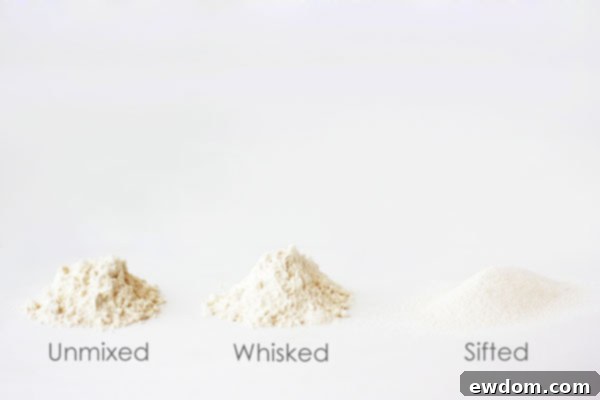
Before we plunge into the practical baking experiment, let’s take a closer look at the fundamental ways whisking and sifting influence dry ingredients, particularly flour. The image above provides a compelling visual demonstration of how these two techniques alter the texture and consistency of flour. When flour is whisked, the wire loops of the whisk move through the flour, effectively separating flour particles and introducing air into the mixture. This process breaks up any small clumps that may have formed during storage and slightly increases the volume of the flour, making it lighter.
Similarly, when flour is sifted, the grain particles are separated, but to a much finer and more uniform degree. This is thanks to the close proximity and fine mesh of the sieve. As the flour cascades through the mesh, it undergoes significant aeration, resulting in an exceptionally fine and fluffy texture. Compared to unmixed flour poured directly onto a surface, whisked flour appears noticeably smoother and more uniform. However, the sifted flour truly stands out with its incredibly delicate, airy, and uniform consistency, showcasing a profound difference in particle separation and aeration.
Beyond Texture: The Crucial Role of Ingredient Distribution
While aeration and lump removal are important benefits, an equally critical reason for whisking or sifting flour is to thoroughly incorporate and evenly distribute other dry ingredients such as salt, baking soda, baking powder (leavening agents), and flavorings throughout the flour. Achieving a uniform distribution is paramount for consistent results in baking. Imagine biting into a cake with an uneven rise or an isolated pocket of salt – these are experiences no baker desires!
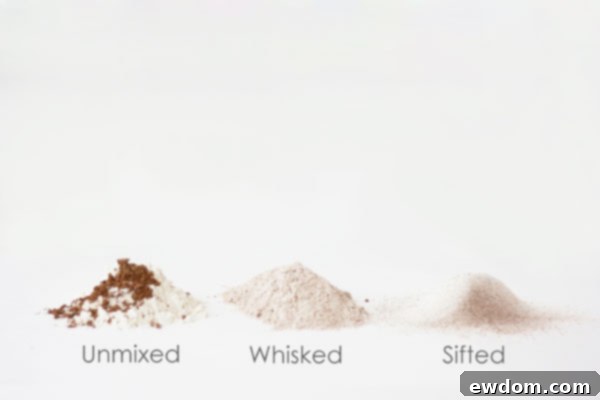
To vividly illustrate the effectiveness of each method in terms of distribution, I conducted a simple yet telling visual test. I added a small amount of cocoa powder to flour under three different conditions: left unmixed, whisked together, and sifted together. The results, as depicted in the image, clearly indicate that whisking emerges as the most effective method for distributing ingredients uniformly. After approximately 20 strokes with the whisk, the cocoa powder was evenly and thoroughly integrated throughout the flour, creating a homogenous mixture. This even distribution is vital for ensuring that leavening agents are present in every part of the batter, leading to a consistent rise and crumb structure.
In contrast, while sifting did improve the distribution of dry ingredients compared to leaving them unmixed, it wasn’t as efficient as whisking. The cocoa powder, in this instance, fell into almost alternating layers and predominately gathered to one side of the sifted heap. This suggests that while sifting excels at separating flour particles and introducing air, its effectiveness in uniformly blending distinct ingredients like cocoa powder or leavening agents might be less reliable than a diligent whisking motion. This observation is particularly important for recipes where consistent rise and flavor are paramount, emphasizing the distinction between mere particle separation and active ingredient blending.
The Real Test: Baking Cakes with Different Dry Ingredient Preparations
Having observed the theoretical effects of whisking and sifting on flour texture and ingredient distribution, it was time to put these insights to the ultimate test: actual cake baking. I must confess, in my own baking, I have often bypassed the separate whisking or sifting step for dry ingredients. My usual routine involves simply sprinkling them into the mixer bowl, which already contains creamed butter, sugar, and eggs. My long-standing assumption has been that a sufficient period of mixing following the addition of dry ingredients would be enough to evenly distribute them throughout the batter. Now, it was time to challenge this personal habit and put my assumption to a rigorous test in a controlled experiment.
For this crucial comparison, I began by creaming together butter and sugar until light and fluffy. Next, I incorporated eggs, flavoring, and liquid to create a foundational wet batter. This base batter was then carefully divided into three equal portions to ensure consistency across the experimental groups. To each third, I added the dry ingredients prepared using one of three distinct methods:
- Unmixed Dry Ingredients: The dry ingredients (flour, leavening, salt) were added directly to the wet batter without any prior whisking or sifting.
- Whisked Dry Ingredients: The dry ingredients were thoroughly whisked together in a separate bowl before being added to the wet batter.
- Sifted Dry Ingredients: The dry ingredients were sifted together through a fine-mesh sieve before being added to the wet batter.
Each portion of batter was then mixed for exactly 1 minute on medium speed after the dry ingredients were incorporated. This controlled mixing time was critical to minimize any further distribution or aeration effects from the mixer itself. Finally, all three cakes were baked simultaneously in identical conditions (oven temperature and time) to ensure that any observed differences were solely attributable to the initial preparation of the dry ingredients.
Surprising Outcomes: Analyzing the Baked Cakes
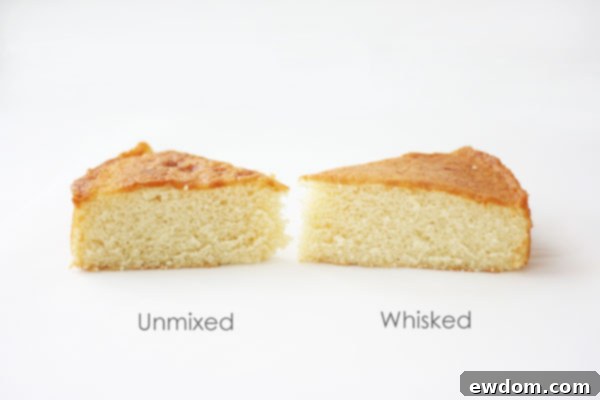
Upon removing the cakes from the oven and allowing them to cool, the initial observations were quite surprising. The cakes prepared with unmixed dry ingredients and those with whisked dry ingredients were remarkably similar, making them difficult to differentiate at first glance. This suggests that for certain recipes or mixing techniques, the additional step of whisking dry ingredients might not produce a drastic change in the final product’s internal structure.
However, a closer inspection revealed a subtle yet distinct difference between these two. The most marked variation was observed in the top crust of the cakes. The cake made with unmixed dry ingredients displayed a slightly mottled or uneven upper crust, indicating potential inconsistencies in ingredient distribution at the surface level. In contrast, the cake made with whisked dry ingredients boasted a noticeably smoother, more uniform top crust. This difference, while subtle, points to the effectiveness of whisking in preventing localized concentrations of ingredients that can lead to uneven browning or texture on the cake’s exterior. Internally, both cakes exhibited a very similar texture, lightness, and mouthfeel, challenging the absolute necessity of pre-mixing dry ingredients when adequate final mixing is performed.
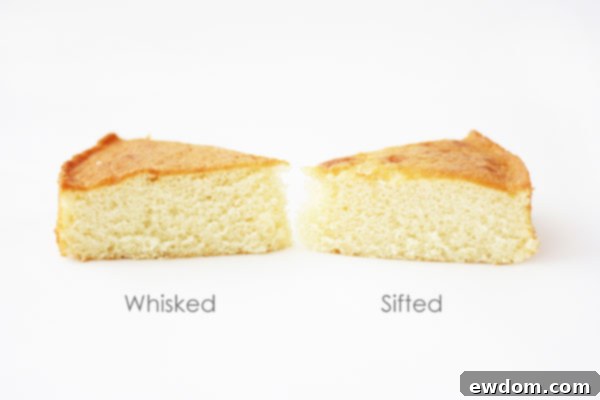
The sifted cake, on the other hand, presented a slightly different profile. It possessed a marginally finer texture compared to its counterparts, aligning with the initial observation that sifting creates a much finer, more aerated flour. This micro-fine crumb might be desirable for certain delicate cake types. Yet, once again, the overall difference in internal texture was surprisingly negligible for a standard cake recipe. What truly surprised me most was an unexpected finding: the sifted cake felt a little drier than both the whisked and unmixed cakes. This outcome was contrary to what one might intuitively expect from a technique designed to create a lighter, more delicate structure.
This dryness can be hypothesized by considering the increased surface area created by thoroughly separating all the flour clumps through sifting. When flour particles are more finely separated and aerated, more surface area of the starch becomes exposed. This increased exposure can potentially lead to greater absorption of fat and liquid during the mixing and baking process. Consequently, the cake might absorb more moisture from the batter, making the final product seem a bit more “cottony” or less moist. This intriguing result highlights a critical point: while sifting excels at particle separation and aeration, it might inadvertently impact the cake’s moisture content, suggesting a delicate balance bakers must consider.
Synthesizing the Discoveries: Sifting vs. Whisking Effectiveness
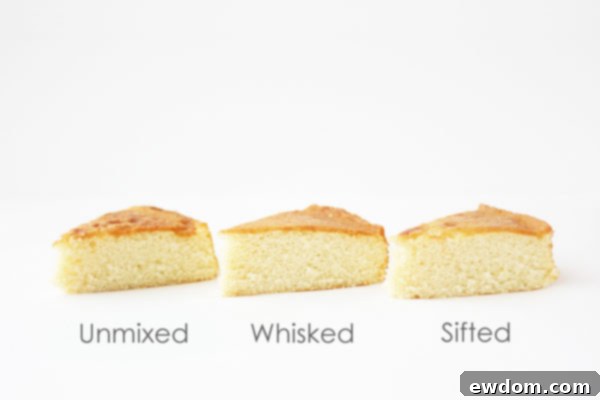
From these experiments, a clearer picture emerges regarding the distinct roles and effectiveness of whisking versus sifting dry ingredients. It appears that the meticulous separation of particles, most highly exemplified by sifting, has a noticeable, albeit subtle, effect on the cake’s final texture. It contributes to a finer crumb, but paradoxically, also seems to influence moisture levels, potentially leading to a drier result due to increased surface area. Conversely, when it comes to the uniform distribution of dry ingredients such as leavening agents and flavorings, whisking unequivocally proves to be the superior and more consistent method.
This distinction is crucial for bakers. If your primary goal is to ensure a perfectly even rise and consistent flavor throughout your cake, a good whisking will serve you best. If an exceptionally fine, delicate crumb is your ultimate pursuit, sifting might offer a slight edge, though one should be mindful of its potential impact on moisture. The experiment demonstrates that the age-old advice of preparing dry ingredients is indeed rooted in science, but the specific method chosen can lead to different nuances in the final product.
Making Your Choice: When to Sift, When to Whisk, and When to Adapt
So, considering these scientific insights, which technique is truly the best for your cake? The answer, as is often the case in the nuanced world of baking, depends heavily on your specific preferences, the type of cake you’re making, and your overall baking process. There’s no universal “one-size-fits-all” rule, but rather informed choices you can make to tailor your results.
- If a very fine, delicate cake texture is your ultimate goal, then sifting your dry ingredients may indeed be beneficial. This technique is particularly popular for light-as-air creations like angel food cakes, chiffon cakes, or very delicate sponge cakes where every bit of aeration and particle separation contributes to their signature ethereal quality. However, be prepared to potentially compensate for a slightly drier result by perhaps slightly increasing the liquid or fat content in your recipe, or by adjusting baking times to prevent over-drying.
- If moisture and consistent rise are more important to you, you might want to reconsider the sifting process or use it judiciously. The slight dryness observed in the sifted cake suggests that extreme particle separation can sometimes work against moisture retention. In such cases, a thorough whisking might be a more suitable method, or you could explore recipes that naturally incorporate more moisture.
- If you tend to minimally mix your cakes after the addition of dry ingredients, perhaps to avoid overworking the gluten, it would be highly advisable to whisk your dry ingredients together before adding them to your wet components. This preliminary whisking ensures that leavening agents, salt, and other flavorings are evenly dispersed, compensating for the limited mixing time in the final stages and guaranteeing a uniform rise and flavor.
- But if your recipe involves a minute or more of mixing after the dry ingredients are added, particularly in stand mixers, the necessity of pre-whisking might be less critical. The mechanical action of the mixer itself will likely achieve adequate distribution. However, whisking still provides a valuable head start, especially for ensuring no stubborn lumps remain hidden.
This experiment challenges the dogmatic adherence to certain baking rules and instead empowers you with knowledge. Understanding the ‘why’ behind each technique allows you to make conscious decisions tailored to your desired outcome. The beauty of baking lies in this flexibility and personal choice; you get to decide how to achieve your perfect cake!
I sincerely hope this deep dive into baking science has clarified and informed the way you approach adding dry ingredients to your recipes. May your cakes always be delicious, consistent, and exactly as you envision them.
Happy baking!