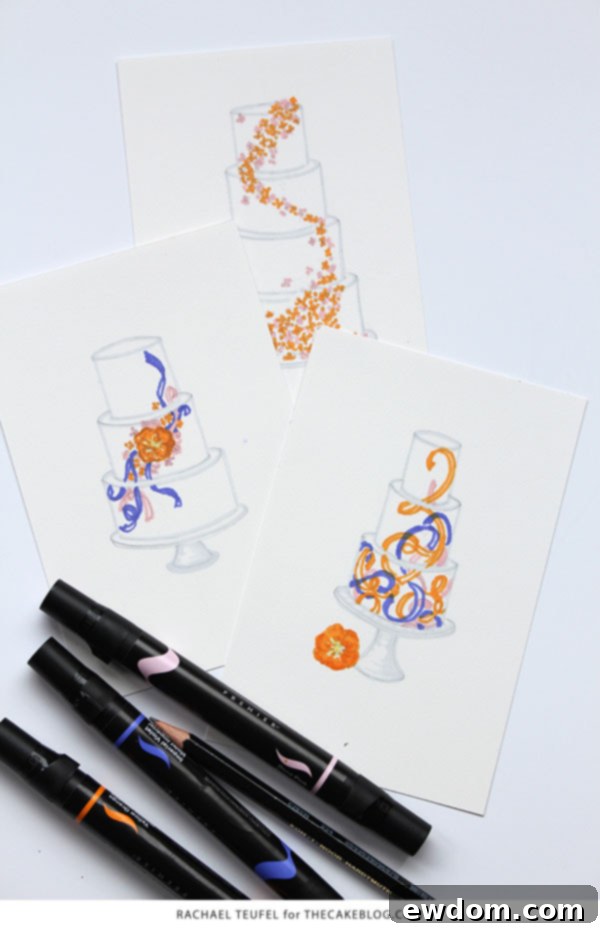
Welcome back to our insightful Design Tips series, where we delve into the core principles that elevate a beautiful cake into a truly extraordinary work of art. This month, we’re thrilled to feature our esteemed contributor, Rachael Teufel of Intricate Icings Cake Design, as she guides us through the fascinating concept of Movement in cake design. Often overlooked, movement is a powerful tool that can transform a static cake into a vibrant, engaging masterpiece that tells a story and captivates the viewer’s gaze.
The Essence of Movement in Art and Cake Design
In the realm of art, movement holds a dual significance. Firstly, it refers to the intentional path the viewer’s eye takes as it explores a piece, a carefully orchestrated visual journey across the canvas or sculpture. Secondly, movement can denote a sense of action, direction, or implied motion within the artwork itself – think of a dancer poised mid-pirouette, or the dramatic crash of ocean waves frozen in time. For cake artists, creating this dynamic sense of movement within a three-dimensional, inherently static medium like a cake presents a unique yet rewarding challenge. By understanding and applying specific design principles, you can imbue your edible creations with an unparalleled sense of life and energy.
Let’s explore some fundamental concepts that will empower you to craft cakes that truly flow and engage.
Guiding the Eye: Creating Visual Flow
The strategic placement of design elements is absolutely paramount in dictating how a viewer’s eye travels across your cake. Our brains are naturally predisposed to find certain geometric configurations aesthetically pleasing and easy to follow. Common and highly effective shapes for guiding the eye include triangular, diagonal, Z-shaped, S-shaped, and C-shaped compositions. These patterns are not arbitrary; they mimic natural pathways and provide a sense of direction that prevents the eye from wandering aimlessly. Instead, the design becomes an inviting journey, revealing details in a deliberate sequence.
Achieving this visual flow isn’t limited to a single technique; it’s a symphony of design choices working in harmony. You can orchestrate eye movement through the judicious use of:
- Color: Bold hues, vibrant contrasts, or subtle gradients can draw attention and create a compelling visual path. A sudden pop of color can serve as a focal point, from which the eye naturally seeks continuation.
- Pattern: Repeating motifs, evolving textures, or a series of dots or lines can create a rhythmic progression that leads the eye across the cake’s surface.
- Texture: Varying textures, from smooth fondant to intricate ruffles or rough sugar details, can create tactile interest that also guides the gaze, inviting closer inspection and follow-through.
- 3D Elements: Sculpted details, sugar flowers, or structural accents that extend from the cake naturally draw the eye, creating shadows and depth that contribute to the overall movement.
- Negative Space (Blank Space): Just as important as what you put on the cake is the space you leave empty. Thoughtfully composed negative space can frame elements, provide breathing room, and direct the eye by contrasting with the decorated areas.
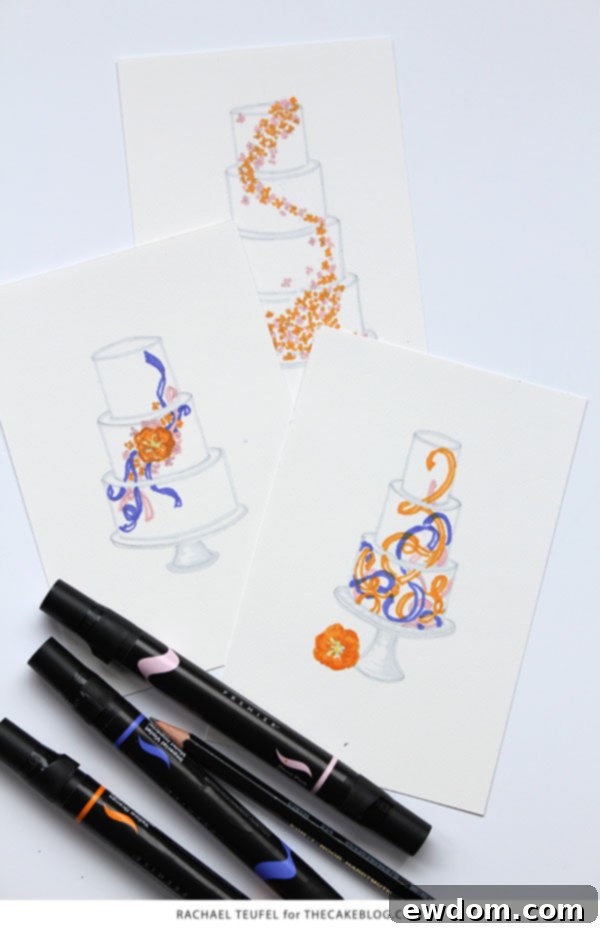
Typically, the viewer’s eye is first drawn to the boldest or most prominent element – the focal point – and then follows the meticulously planned path through the rest of the piece. Let’s illuminate these concepts with some illustrative sketches.
The Graceful S-Curve: A Path of Whimsy
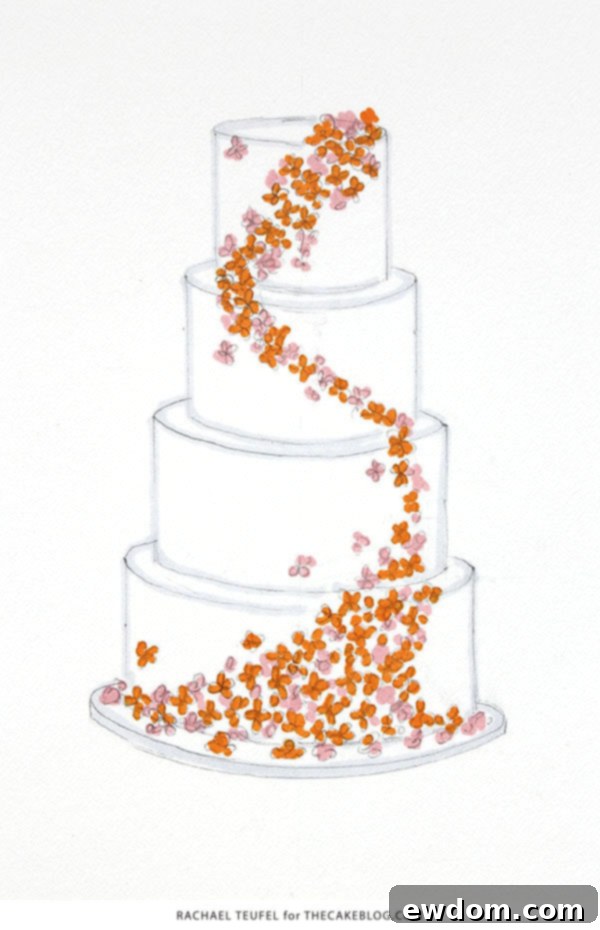
In this initial sketch, observe how the design elements are artfully arranged in an S-shaped configuration. This classic curve is inherently elegant and dynamic, creating a natural sense of flow and progression. Here, the delicate butterflies appear to flitter effortlessly from the bottom tier of the cake towards its apex. The S-curve provides a gentle, continuous pathway for the eye, suggesting upward motion and lightness, much like a natural spiral or a winding vine. This configuration imbues the static cake with a feeling of airy movement, as if the butterflies are truly ascending.
Dynamic Diagonals: Injecting Energy and Drive
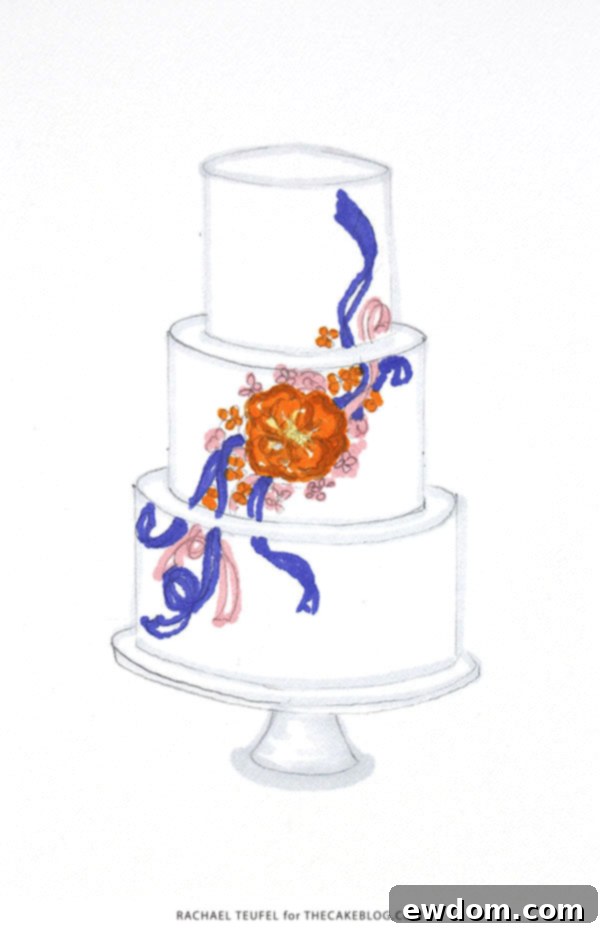
Our second sketch demonstrates another incredibly effective technique for generating movement: simply arranging design elements along a diagonal axis. Unlike the static stability of purely vertical or horizontal placements, diagonal lines introduce tension, energy, and a palpable sense of direction. They break the monotony and immediately suggest action or transition. In this example, the elements are not just placed; they are propelling, creating a visually stimulating journey that implies speed and dynamism. The eye moves quickly along the diagonal, creating a more energetic and modern feel to the design.
Creating Implied Motion: Action and Dynamism
Beyond guiding the viewer’s eye, movement in art can also refer to the illusion of action or motion within a piece. This is often achieved by depicting objects in a state that suggests they are actively moving, even when represented in a static form. In traditional art, this might involve speed lines behind a cartoon car to show propulsion or capturing a figure in a pose that couldn’t be held without ongoing motion. For cake designers, translating this concept into edible art requires creativity and an understanding of visual cues.
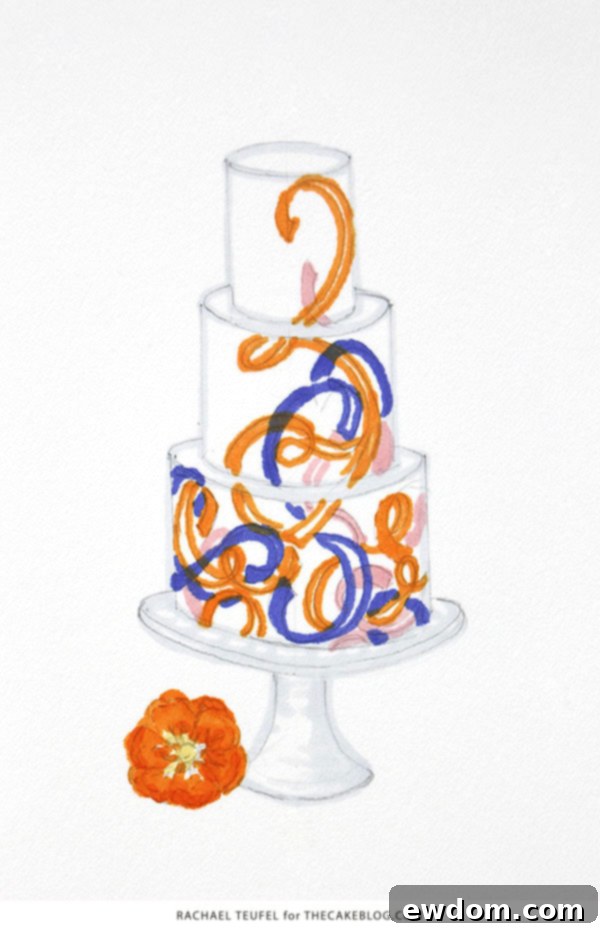
Ribbons in the Wind: A Frozen Moment of Action
This final sketch beautifully illustrates the creation of implied action movement. Here, the ribbons are depicted as though they are caught mid-swirl, blowing gracefully in an unseen breeze. The natural undulations, twists, and overlapping forms of the ribbons convey a dynamic energy, freezing a fleeting moment of motion. This technique doesn’t just guide the eye; it tells a story of an external force, adding an element of life and drama to the design. It’s a testament to how even simple elements, when arranged thoughtfully, can evoke powerful sensations of movement.
Bringing Movement to Life: Rachael’s Swirling Ribbons Cake
Inspired by the concept explored in sketch number three – the enchanting visual of rippling, wind-swept ribbons – I set out to translate this dynamic energy into a tangible cake design. My goal was to craft a cake that not only looked beautiful but also felt alive, inviting the viewer’s eye on an exhilarating journey.
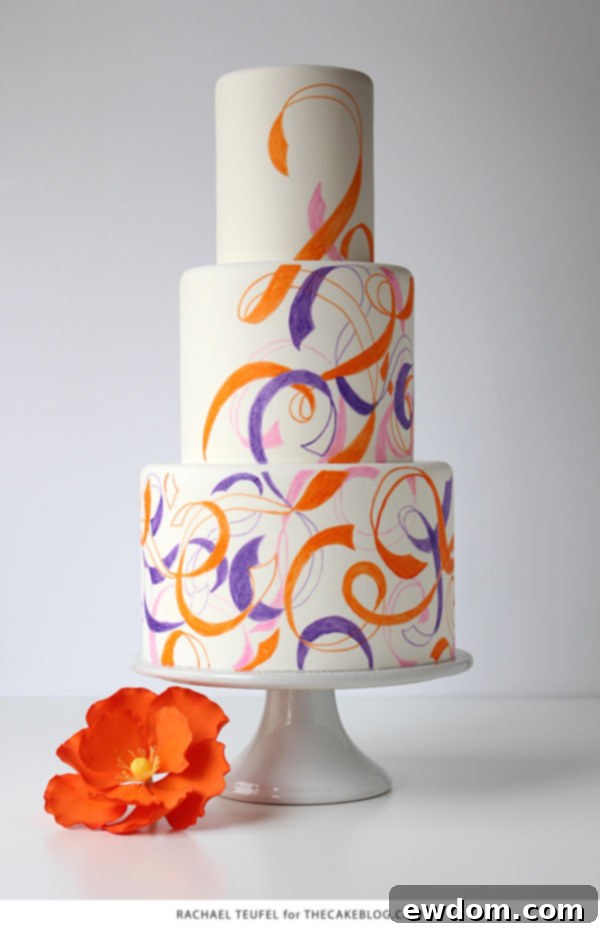
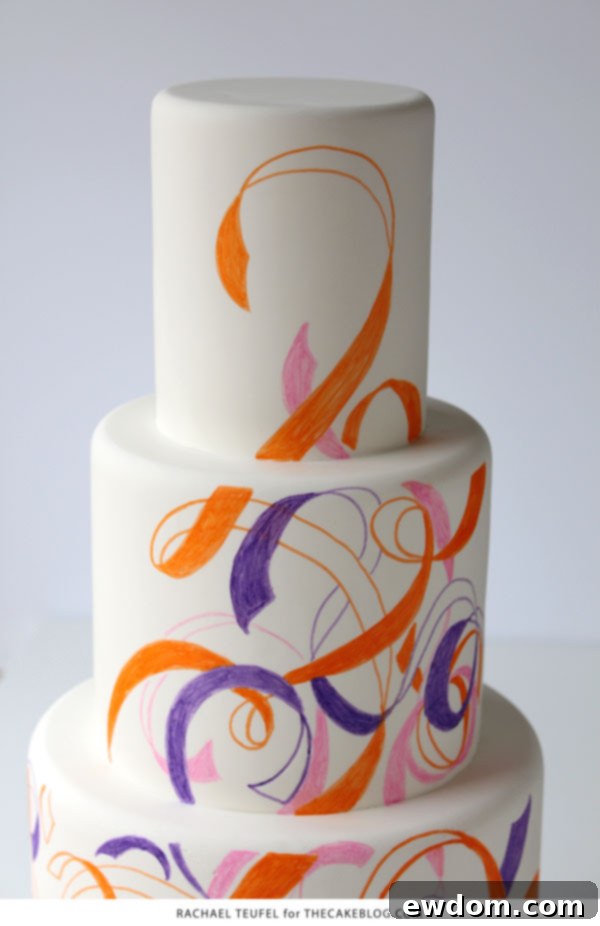
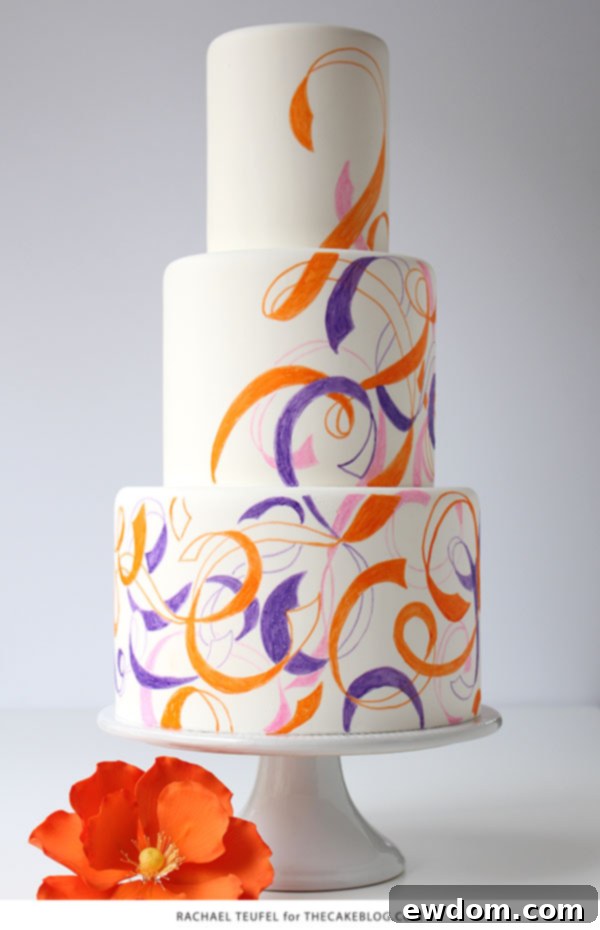
To achieve the desired effect of movement, I opted for a design featuring several ribbons that appear to twist, turn, and intertwine around the cake. The choice of solid colors and meticulously clean lines was deliberate; it allowed the forms of the ribbons themselves to dictate the visual flow, ensuring clarity and impact. Each ribbon was carefully rendered onto fondant using edible markers, allowing for precision in depicting their intricate overlaps and dramatic curves. The crispness of the lines emphasizes the sharp turns and gentle bends, enhancing the illusion of motion.
To anchor the design and provide a captivating starting point for the viewer’s eye, I strategically placed a vibrant, bright orange anemone at the base of the cake. This stunning sugar flower serves as a powerful focal point, its vivid hue instantly drawing attention. From this striking point of interest, the eye is then effortlessly guided upwards and around the cake, following the elegant, flowing path of the swirling ribbons. The interplay between the static, bold flower and the implied motion of the ribbons creates a harmonious balance, showcasing the power of strategic element placement.
Elevating Your Cake Design Skills: Practical Tips for Incorporating Movement
Now that you’ve grasped the fundamental principles of creating movement, it’s time to put theory into practice. The next time you embark on sketching a new cake concept, intentionally incorporate these ideas. Don’t be afraid to experiment and push the boundaries of your creativity. Here are a few additional tips to help you along the way:
- Sketch Liberally: Before committing to sugar, explore various configurations on paper. Draw multiple versions of your design, focusing solely on how elements are arranged to create flow and action.
- Seek Inspiration Everywhere: Look beyond cakes. Observe how movement is portrayed in nature (wind-blown leaves, flowing water), architecture (curving staircases, dynamic facades), fashion (draping fabrics), and fine art. Translate these observations into cake elements.
- Utilize Contrast: Movement is often enhanced by contrast. This could be contrast in color, size, texture, or even the direction of lines. A sharp turn in a ribbon is more impactful against a smooth background.
- Think in Layers: Overlapping elements naturally create depth and a sense of progression. Think about how elements can partially obscure and reveal others, leading the eye deeper into the design.
- Practice the “Why”: As you design, always ask yourself: “Why am I placing this element here? What is its purpose in guiding the eye or implying action?” Understanding the ‘why’ will make your design choices more deliberate and effective.
- Start Simple: Begin with one or two elements to create a clear path before attempting more complex multi-directional movements. Master the S-curve or diagonal before combining them.
- Review from Different Angles: A cake is a 3D object. Walk around your sketch or mock-up. Does the movement hold up from all perspectives?
Embracing movement in your cake designs will not only make your creations more visually captivating but will also significantly expand your artistic repertoire. You’ll be pleasantly surprised as you witness your design skills blossom and your cakes acquire a new level of sophistication and dynamic appeal. If you ever find yourself needing a creative boost or a quick refresher on these principles, simply revisit this post!
VENDORS & CREDITS
Cake : Intricate Icings Cake Design
Learn From This Baker : Online Cake Classes with Rachael Teufel on Craftsy
YOU MAY ALSO LIKE:
Design Tips : Inspiration
Design Tips : Balance